Showing posts with label rhode island. Show all posts

October 31, 2018

Rules Near for Renewables on Farms and Open Space


The struggle between open space and renewable energy is playing out on Rhode Island farms.

Some farmers see wind turbines and solar fields as a boost to their modest and often unpredictable income. They say renewable energy can keep a farm practicing traditional agriculture instead of being forced to sell farmland — a tempting option given that Rhode Island farmland is the most expensive in the country.

May 23, 2018

R.I. Lawmakers Poised to OK Biomass Bill


Foes say a wood burning plant in Johnston would release carbon and potential contaminants.

Despite the objections of environmental groups, the General Assembly is poised to expand a key state renewable energy program in support of a so-called biomass power plant being contemplated in Johnston that would burn wood waste to generate electricity.

The plant is being proposed by North Kingstown-based Green Development, the company that is a lead player in a debate in Rhode Island over the installation of solar arrays in woodlands and farm fields. Green Development has also installed more land-based wind turbines in Rhode Island than any other company, including 10 in Coventry and another seven going up near the Central Landfill in Johnston.

The biomass bill won Senate approval early this month and cleared the House Committee on Corporations on Tuesday. A vote by the full House had yet to be scheduled as of Wednesday afternoon.

A spokesman for Green Development said the company won’t be able to build the biomass plant without the change in law.

“Unless you attach biomass to net metering, the economics simply do not make sense,” said Bill Fischer.

He and others say the bill would help expand Rhode Island’s renewable energy portfolio by offering the same incentives to biomass that wind and solar power already receive.

The legislation would include biomass in the 2011 state net metering law, which allows entities to offset their electric bills through the sale of renewable energy to the power grid.

The change would bring the law in line with the state’s Renewable Energy Standard, which passed in 2004 and includes biomass as a qualifying source. No biomass projects have been developed yet in Rhode Island. National Grid, however, does buy large amounts of biomass power from other parts of New England to meet the annual targets set by the Renewable Energy Standard.

Rep. Kenneth A. Marshall, the Bristol Democrat who introduced the bill in the House, said it makes no sense to purchase biomass power from out of state and not offer incentives to develop it in-state.

“You can’t say that we have a mandate to reach an environmental goal and on the flip side say, ‘We don’t want that to happen,’” Marshall, the senior deputy majority leader, said in an interview.

In written testimony to the legislature, Mark DePasquale, the founder of Green Development, argued that his new plant will use wood waste that would otherwise be thrown away in the Central Landfill and would release methane as it breaks down. (There is a biogas plant at the landfill that burns methane.)

“Rather than throw it away, we would like to process the clean wood in a highly engineered biomass plant to generate steady, baseload power and reduce greenhouse gas production while increasing our energy independence,” he wrote.

But environmental groups that include the Conservation Law Foundation and the Acadia Center counter that burning wood waste will produce carbon emissions and nitrous oxides. They also say that if the plant were to burn other construction or demolition debris, it would release potential contaminants from lead paint and arsenic.

“Expanding use of biomass will increase conventional air pollution by subsidizing a technology — wood burning — that is one of the largest sources of air pollution in the U.S. per megawatt hour of energy produced,” James Bryan McCaffrey, of the Partnership for Policy Integrity, wrote in testimony to the General Assembly.

Johnathan Berard, Rhode Island director of Clean Water Action, wrote in an email, “This legislation would not only undo [Rhode Island’s] long-standing ban on incineration ... but it is clearly a quid pro quo for a prominent campaign donor.”

DePasquale has made more than $30,000 in campaign contributions over the past seven years to state government leaders, including House Speaker Nicholas Mattiello, Senate President Dominick Ruggerio and Gov. Gina Raimondo.

This is not the first time legislation has been proposed that would help DePasquale’s company.

Under its previous name, Wind Energy Development, it was at the center of a Smith Hill controversy two years ago when the proposed House budget bill included a provision that would have sidestepped a decision by the state Public Utilities Commission and potentially shifted some of the costs to ratepayers for connecting renewable energy to the power grid.

The language in the budget bill was lifted from legislation introduced by then-state Rep. John Carnevale that failed to win passage. Carnevale ended his campaign for reelection after a WPRI story raised questions about whether he resided in the district he represented.

After The Journal wrote about the proposed provision and the way it was designed to help DePasquale’s wind project in Coventry, it was removed from the budget legislation.

The back and forth over biomass is playing out nationally. Last month, U.S. Environmental Protection Agency administrator Scott Pruitt announced his agency’s determination that biomass is carbon neutral, but opponents of the policy change say it ignores the air pollution caused by burning wood and encourages the felling of trees.

Marshall said that new biomass technology recaptures smoke and burns it to reduce emissions. He also said that the plant in Johnston would only use stumps, wood pallets and other wood waste and not other debris or fresh-cut trees.

The DEM, the state Office of Energy Resources and the Division of Public Utilities and Carriers have all taken a neutral position on the legislation.


July 23, 2017

Assembly OK’s Ruggiero Bill for Remote Net Metering at Schools and Churches in Rhode Island

The state legislature has approved a bill that could significantly increase renewable energy by expanding net metering to schools, hospitals and nonprofit organizations, including churches.
Rep. Deb Ruggiero, who represents Jamestown and Middletown, co-sponsored the bill in the House.

Net metering allows the owners of green energy to receive credit for the power they feed into the electric grid. Remote net metering is an arrangement that allows kilowatt-hours generated from one site to be credited toward energy consumption at a different site.

July 20, 2016

Gov. Raimondo Signs Renewable Energy Measures into Law in RI

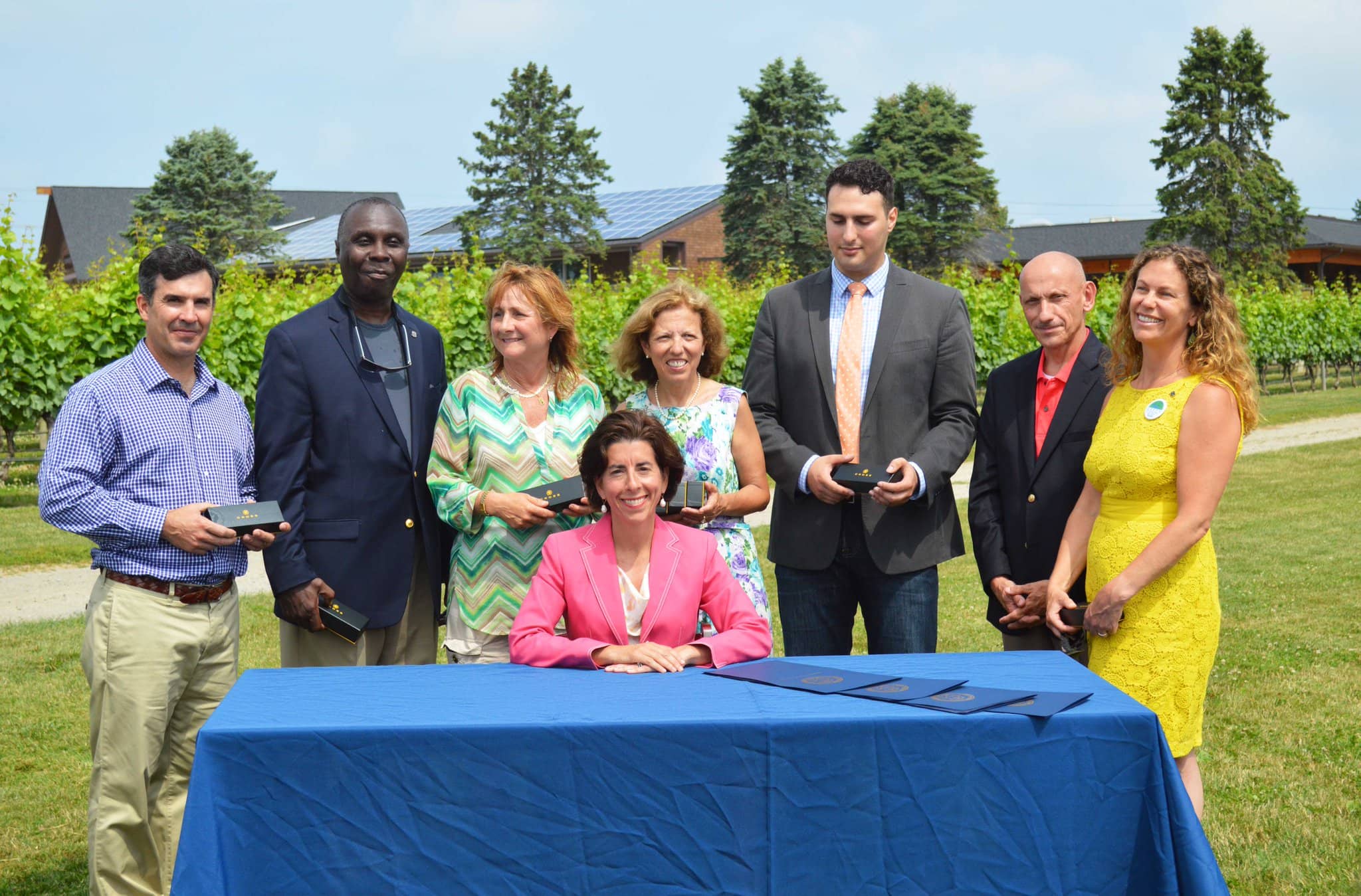
 Joined by state legislators and other officials on Thursday, Gov. Gina M. Raimondo, D-R.I., ceremonially signed into law several bills meant to advance renewable energy in Rhode Island. Furthermore, the governor and SolarCity announced that the rooftop solar company will be expanding its operations in the state.

According to a press release from the General Assembly, one of the bills was H.7413A/S.2185A, which extends the state’s renewable portfolio standard (RPS) from 14.5% by 2019 to 40% by 2035. State lawmakers approved the bill in late June, and the governor technically signed it shortly afterwards.

July 10, 2016

Rhode Island Clean Power Boost

US state almost triples renewables standard to 40% by 2035

Rhode Island has nearly tripled the state’s renewable energy standard to 40% by 2035, up from 14.5% by 2019.

Governor Gina Raimondo signed the legislation into law this week.

“By raising its renewable energy standard, Rhode Island is sending the signal that it’s open for business to renewable energy developers who will invest billions of dollars into the state economy,” said American Wind Energy Association CEO Tom Kiernan.

According to the Wind Energy Foundation, growing wind power in Rhode Island could result in $240m in electricity bill savings by 2050 and up to $744m in savings through lower gas prices.

Rhode Island joins a growing number of states, including California, Oregon, Vermont and Hawaii, raising their existing renewable energy laws.


Source

July 1, 2016

R.I. Legislature Passes Bill To Boost Renewable Energy Target

The Rhode Island legislature has passed a bill to advance the state’s renewable energy target from 14.5% by 2019 to 40% by 2035 – a move being applauded by the American Wind Energy Association (AWEA).

The new law, if signed by Gov. Gina Raimondo, would ensure Rhode Island homeowners and businesses have greater access to renewable energy, including wind power, explains AWEA, adding that wind farm investment in Rhode Island has attracted $20 million in total capital investment to the state economy.

April 18, 2016

Senate OKs Walaska Bill Expanding Renewable Energy Growth Program


Sen. William A. Walaska (D-Dist. 30, Warwick)’s bill extending the Renewable Energy Growth Program through 2029 passed the Senate today along with two other clean energy bills, all of which now wait on action in the House.

The Renewable Energy Growth Program allows small renewable energy producers, such as homes with rooftop solar panels, to sell their surplus energy to national Grid at a set price over a set period of time (15 to 20 years), according to the Legislative Press and Public Information Bureau. The program figures critically in the financing of such small projects.

The program provides a set price for the purchase of electricity by National Grid from small scale projects throughout the state. Should Walaska’s bill become law, the program will handle an additional 400 MW of renewable energy over 10 years.

February 12, 2016

Raimondo's Budget Plan Aims to Boost Renewable Energy Systems Throughout R.I.

Add caption
In December, in a bid to cut Rhode Island’s carbon footprint, Governor Raimondo signed an executive order to acquire all the power used by state-owned buildings from renewable sources by 2025.

As part of her budget plan announced last week, the governor has put forward a set of proposals that aims to expand the development of renewable energy throughout the rest of the state.

The budget article contains three provisions that would reduce the costs of solar arrays, wind turbines and similar energy systems and make it easier to install them.

February 1, 2015

Rhode Island Environmental Groups Set 2015 Priority Issues

 A statewide ban on plastic shopping bags and more composting are among several key issues being advanced by Rhode Island environmentalists this year.

Last week, the Environment Council of Rhode Island (ECRI), an advocacy groups for 60-plus environmental groups, announced its legislative priorities on issues of energy, land and water, waste, transportation and the budget.

March 9, 2014

Rhode Island Lawmakers Look to Expand Renewable-Energy Program

State lawmakers have filed legislation to expand the program that has been most effective in spurring the development of renewable energy in Rhode Island.

The bill proposes a five-fold increase by 2020 of the program that awards long-term power contracts to solar arrays, wind turbines and other types of clean energy, from the current 40 megawatts in nameplate capacity to 200 megawatts.

July 7, 2013

R.I. Legislation Allows New Investments in Renewable Energy

Before the General Assembly adjourned earlier this week, legislators passed a bill that aims to bolster investment in renewable energy and improve energy efficiency.

May 13, 2012

Rhode Island bill builds wind authority

The House Bill, H7592 was introduced by Representatives Gallison, Malik, Morrison, Edwards, and Handy on February 16, 2012.

The Senate Bill 2870 is sponsored by Senator Lou De Palma, with the support of Senators Paiva-Weed and Chris Ottiano. It has been deemed to be a "dangerous" bill by Rhode Island Statewide Coalition, is too far-reaching, and has too much power. It is another Deepwater Wind, but far worse due to the power of eminent domain!

May 1, 2012

Rhode Island Senate committee debates energy efficiency

The slow track of environmental bills followed their usual course at an April 4 hearing in the Senate Committee on the Environment and Agriculture.

Biofuels
A bill encouraging the local production of biofuels and biodiesel in particular was debated at length then held for study. Ray Albrecht from the National Biodiesel Board described biodiesel as homegrown energy. "It doesn't have to come from major corporations. It can be done right here in your hometown," he said.

October 23, 2011

Rhode Island’s renewable energy laws


By Representative Deborah Ruggiero

Rhode Island ranks among the lowest 10 states in the country when it comes to renewable energy. However, in the 2011 session, the General Assembly passed a suite of renewable energy laws -- some of the most cohesive and comprehensive in the nation—that will leap frog Rhode Island from laggard to leader in renewable energy.  It’s more than just protecting our environment, it’s about creating jobs in our state.